NEMT vs. Rideshare: What's the Difference?

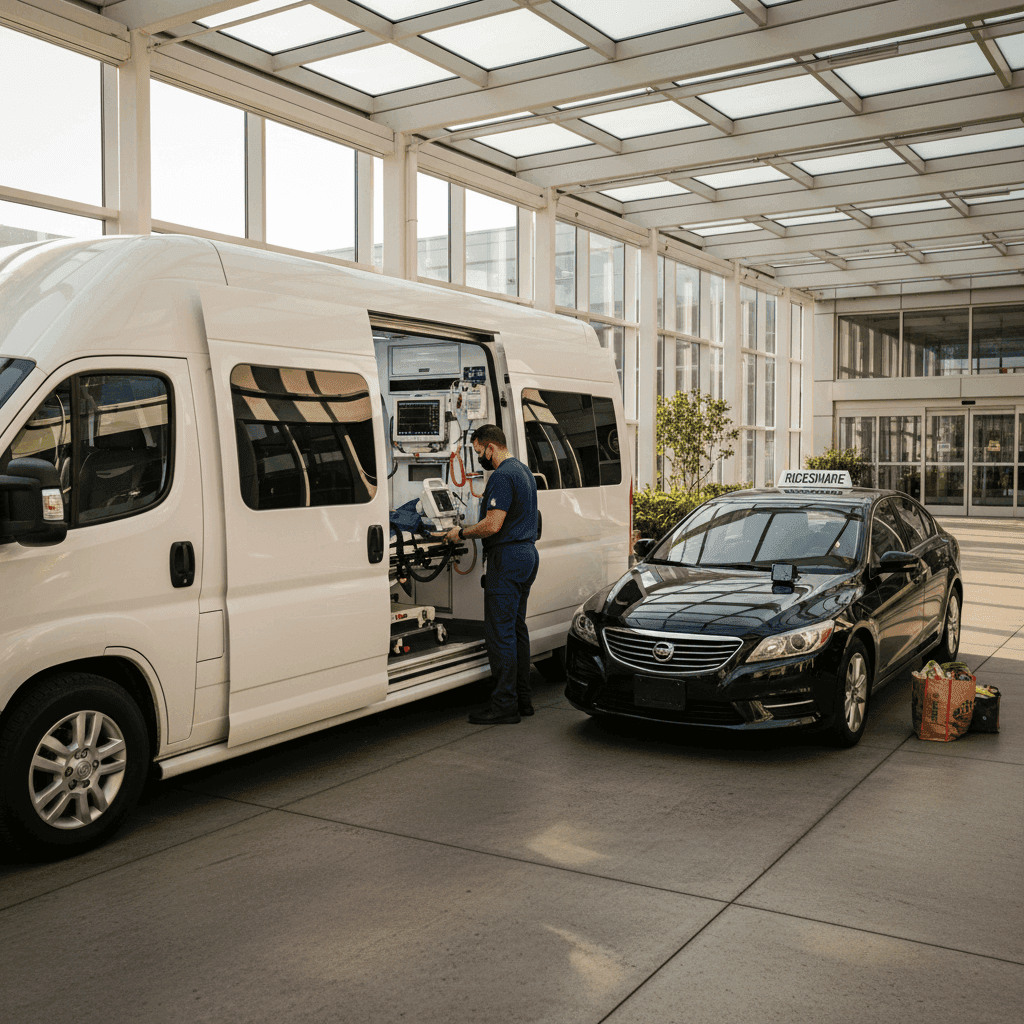
Uber WAV and Lyft Access offer wheelchair-accessible vehicles in select major cities, but both are curb-to-curb only with no trained patient handling — and both are prohibited by most surgery centers after sedation. If you or a loved one needs medical transportation, understanding the difference between non-emergency medical transportation (NEMT) and rideshare services is not optional — it is a safety issue.
This guide explains exactly what separates NEMT from rideshare, walks through six real situations where rideshare fails, describes what NEMT drivers are trained to do, compares costs, and identifies when rideshare is a perfectly reasonable choice. By the end, you will know which service fits your situation — or the situation of the person you are caring for.
Need wheelchair, stretcher, or attended transport?
6 Situations Where Rideshare Fails and NEMT Is Required
Rideshare works well for millions of trips every day. But medical transportation is different. The following six situations illustrate exactly where Uber and Lyft fall short — and why NEMT exists.
1. Wheelchair Users Who Cannot Transfer to a Car Seat
Standard rideshare vehicles are sedans and SUVs with no wheelchair ramp or lift. If a patient cannot physically transfer out of their wheelchair and into a car seat, rideshare is not an option. Even Uber WAV, which is available in limited markets, has unpredictable availability with wait times that can exceed 45 minutes — making it unreliable for time-sensitive medical appointments.
NEMT providers like Dream Care Rides operate wheelchair-accessible vans equipped with hydraulic lifts or ramps and Q'Straint four-point securement systems. The patient rolls into the vehicle in their chair, the driver locks the chair to the floor using FMVSS-compliant restraints, and the patient rides secured and upright to their appointment. Learn more about our wheelchair transportation services in Chicago.
2. Patients Leaving Surgery or Sedation Procedures
After sedation, general anesthesia, or even moderate conscious sedation (common for colonoscopies, dental surgery, cataract procedures, and outpatient orthopedic surgery), the patient cannot be released to an unaccompanied rideshare driver. Surgery centers require a named responsible person who will physically assist the patient and remain with them.
NEMT drivers meet this requirement. They check in with the facility, assist the patient from the recovery area to the vehicle, and provide door-through-door service to the patient's home. The driver is trained in post-procedure patient handling and understands that sedated patients may be unsteady, drowsy, or disoriented during transport.
3. Stretcher Patients Who Must Travel Lying Down
Some patients cannot sit upright due to spinal injuries, recent hip or back surgery, severe pain conditions, or medical device requirements. These patients need stretcher transport — a vehicle equipped with a gurney, secured at multiple points, with climate control and medical-grade compartment space.
Rideshare vehicles obviously cannot accommodate a stretcher. Dream Care Rides stretcher transport is $350–$400 base plus $6.00 per mile after the first 5 miles, reflecting the specialized vehicle, two-person crew, and medical-grade equipment required.
4. Patients Who Need Help with Stairs, Doorways, or Narrow Hallways
Many elderly and mobility-impaired patients live in homes with stairs, narrow hallways, or doorways that make exiting the home difficult. Rideshare is a curb-to-curb service — the driver waits at the curb and is not set up to enter a patient's home, assist with stairs, or navigate through tight spaces with a walker or wheelchair. For patients who need help getting from their bed or living room to the vehicle, a dedicated NEMT service level is the right fit.
NEMT provides door-through-door and even bed-to-bed service levels. The driver enters the home, assists the patient from their bed or living room, navigates stairs with proper technique, and guides them into the vehicle. This level of assistance is the core difference between NEMT and any other transportation option.
5. Patients Traveling with Medical Equipment
Portable oxygen concentrators, IV poles, wound VAC devices, and other medical equipment require secure placement during transport. A rideshare driver may refuse a passenger with bulky medical equipment or have no way to safely secure it in the trunk or cabin.
NEMT vehicles have designated space for medical equipment and drivers trained to handle oxygen tanks, secure portable devices, and ensure nothing shifts during the ride. This is especially critical for dialysis patients who may travel with peritoneal dialysis supplies or home hemodialysis equipment.
6. Solo Seniors Who Need a Familiar, Reliable Driver
For elderly patients living alone, especially those with early-stage cognitive decline, anxiety disorders, or hearing impairments, a random rideshare driver creates genuine distress. The vehicle is different every time. The driver is unfamiliar. There is no assistance into or out of the car, and no one ensures the patient actually gets inside the medical facility.
NEMT providers assign consistent drivers for recurring patients. The driver knows the patient by name, understands their mobility needs, and walks them through the facility entrance. For patients who attend dialysis three times per week or physical therapy twice per week, this consistency is not a luxury — it is a safety net that reduces missed appointments and fall risk.
What NEMT Drivers Are Trained to Do That Rideshare Drivers Are Not
The single biggest difference between NEMT and rideshare is not the vehicle — it is the driver. NEMT drivers complete extensive training that rideshare platforms do not require, including:
- Wheelchair securement: Operating hydraulic lifts, deploying ramps, and locking wheelchairs using Q'Straint four-point securement systems to FMVSS standards. An improperly secured wheelchair can shift or tip during sudden braking, causing serious injury.
- Patient assist and transfer: Helping patients stand from a bed or chair, guiding them with a gait belt, navigating stairs safely, and transferring from wheelchair to vehicle seat when applicable. These techniques reduce fall risk and protect the patient's dignity.
- CPR and First Aid: All Dream Care Rides drivers maintain current CPR and First Aid certification. While NEMT is non-emergency, medical events can occur during transport, and the driver must be prepared to respond.
- HIPAA compliance: NEMT drivers are trained to protect patient health information. They do not discuss a patient's medical condition, destination, or scheduling with unauthorized parties.
- Defensive driving and vehicle safety: Training specific to passenger transport vehicles, including smooth acceleration and braking techniques for patients with pain conditions, spinal injuries, or motion sensitivity.
- Sensitivity and communication: Working with elderly patients who may have hearing loss, cognitive impairment, or anxiety about leaving home. Working with disabled patients who need specific communication approaches or additional transfer time.
Rideshare is a curb-to-curb transportation product designed for ambulatory adults who can walk to the curb, open the door, sit down, and buckle their own seatbelt — a different category of service than dedicated NEMT. For patients who need physical assistance, wheelchair securement, door-through-door escort, or help with medical equipment, Dream Care Rides provides the higher service level with drivers who have completed the certifications listed above.
Cost Comparison: NEMT vs. Rideshare in the Chicago Area
Cost is a real concern for patients and families. Here is a transparent comparison of what you can expect to pay in the Chicago metro area for different transport types. NEMT rows show Dream Care Rides' starting base rates plus mileage, per one-way leg.
| Service Type | Base Fare | Per Mile | Includes |
|---|---|---|---|
| Uber / Lyft | $15 - $40 | Varies (surge) | Curb-to-curb, no assistance |
| Ambulatory NEMT | $30–$60 | $3.00/mi after the first 3 miles | Door-to-door, trained driver, wait time |
| Wheelchair NEMT | $40–$70 | $3.50/mi after the first 3 miles | ADA vehicle, lift/ramp, securement, attendant |
| Stretcher NEMT | $350–$400 | $6.00/mi after the first 5 miles | Gurney, 2-person crew, medical compartment |
The price difference reflects equipment, training, insurance, and service level. An ambulatory NEMT trip costs roughly $20 to $40 more than a rideshare — but includes a trained driver who will walk you to the facility entrance, wait for your appointment, and drive you home. For patients who need stretcher service, rideshare is not an option at any price. For wheelchair patients, Uber WAV is curb-to-curb only where available, which is insufficient for most medical appointments that require a higher service level. See our full private pay pricing for transparent, upfront rates.
When Rideshare Is a Perfectly Reasonable Choice
Not every medical trip requires NEMT. Rideshare is appropriate — and often the better choice — when all of the following conditions are true:
- You can walk independently to the curb without physical assistance
- You do not use a wheelchair, walker, or other mobility device
- You are not recovering from sedation, anesthesia, or any procedure that impairs alertness
- You do not need help getting into or out of the vehicle
- You are not carrying medical equipment that requires secured transport
- Your medical facility does not require a named transport provider for discharge
A healthy adult traveling to a routine checkup, blood draw, dermatology appointment, or dental cleaning can safely use Uber or Lyft. If your medical situation changes — for example, you are told during a visit that you need a biopsy with sedation next week — that is when you should plan NEMT for the return trip.
How to Decide: A Quick Assessment
Use these five questions to determine which service you need. If you answer yes to any of them, NEMT is the appropriate choice:
- Do you use a wheelchair, power chair, or scooter? If yes, you need an ADA-compliant wheelchair vehicle with trained securement. Standard rideshare is not equipped for this, and Uber WAV (where available) is curb-to-curb only with no trained patient handling.
- Will you be sedated or under anesthesia during your appointment? If yes, your facility will require a named transport provider for discharge. Book NEMT in advance.
- Do you need physical help getting from your home to the vehicle? If yes, you need door-through-door or bed-to-bed NEMT service. Rideshare provides curb-to-curb only.
- Are you traveling with medical equipment like oxygen or a wound VAC? If yes, NEMT vehicles have secure storage and trained handlers for medical devices.
- Must you travel on a stretcher or gurney? If yes, only stretcher NEMT can transport you. There is no rideshare equivalent.
If you answered no to all five questions, rideshare is likely appropriate. If you are still unsure, learn about our 6 service levels to understand exactly which type of NEMT matches your needs, or read our complete guide to payment options to understand what your insurance may cover.
Not Sure Which Service You Need?
Call us and describe your situation. We will tell you exactly which service level fits — and if rideshare is sufficient, we will tell you that too.
Frequently Asked Questions: NEMT vs. Rideshare
Can Uber or Lyft transport a wheelchair user?
Standard Uber and Lyft sedans are not wheelchair-accessible. Uber WAV and Lyft Access offer wheelchair-accessible vehicles in select major cities including Chicago, but both are curb-to-curb programs — the driver remains with the vehicle. Suburban availability is unpredictable and advance scheduling for recurring medical appointments is unreliable. Dream Care Rides provides a higher service level: door-to-door and door-through-door wheelchair transport on every booking, with drivers who complete PASS wheelchair securement certification and secure chairs with Q'Straint four-point retractor systems to FMVSS standards on every trip.
Is it safe to take a rideshare home after surgery or sedation?
Most surgery centers and hospitals explicitly prohibit patients from using rideshare services after receiving sedation or general anesthesia. The facility typically requires a named, responsible person who can physically assist the patient into the vehicle and monitor them during transport. NEMT drivers fulfill this requirement because they are trained in patient assist techniques and sign in at the facility as the responsible transport provider. If you attempt to call an Uber after a procedure involving sedation, the discharge nurse will likely not release you.
How much does NEMT cost compared to Uber or Lyft?
Rideshare trips in the Chicago area typically range from $15 to $40 for a one-way trip depending on distance and surge pricing. At Dream Care Rides, ambulatory NEMT is $30–$60 base plus $3.00 per mile after the first 3 miles. Wheelchair NEMT is $40–$70 base plus $3.50 per mile after the first 3 miles. Stretcher transport is $350–$400 base plus $6.00 per mile after the first 5 miles. Base rates are per one-way leg; a round trip is two legs. The higher NEMT cost reflects specialized equipment, trained attendants, ADA-compliant vehicles, and door-through-door assistance that rideshare cannot provide.
Does Medicaid cover rideshare for medical appointments?
Medicaid does not directly reimburse Uber or Lyft rides. However, some Medicaid managed care organizations and transportation brokers have partnered with rideshare companies to offer ambulatory-level rides through their networks. These rides are booked through the broker, not through the rideshare app directly. If you need wheelchair, stretcher, or attended transport, Medicaid will assign an NEMT provider. Contact your MCO or call Dream Care Rides at (708) 505-6994 for private pay options.
When is rideshare actually appropriate for a medical appointment?
Rideshare is appropriate when the patient can walk independently without assistance, does not use a wheelchair or mobility device, is not under sedation or anesthesia, does not need help getting into or out of the vehicle, and does not require medical monitoring during transport. A healthy adult going to a routine checkup, blood draw, or dermatology visit can safely use Uber or Lyft. When in doubt, ask your medical provider whether you need attended transport.
What training do Dream Care Rides NEMT drivers complete?
DCR drivers complete PASS wheelchair securement certification using Q'Straint systems, patient lift and transfer techniques, CPR and First Aid certification, defensive driving for passenger vehicles, HIPAA compliance for patient privacy, and sensitivity training for elderly and disabled passengers. Rideshare is a curb-to-curb transportation service built for ambulatory riders — a different category of service. Surgery centers, dialysis clinics, and hospitals require dedicated NEMT rather than rideshare for patients who need physical assistance, door-through-door escort, or hand-to-hand service.
Can I use a rideshare if I need to bring medical equipment like oxygen?
Rideshare is a standard passenger-vehicle service, and drivers may decline passengers carrying oxygen concentrators, IV poles, or other medical devices. Dream Care Rides NEMT vehicles are designed to accommodate medical equipment safely, and our drivers are trained to secure oxygen tanks and portable devices during transit. If you rely on supplemental oxygen or travel with medical equipment, a dedicated NEMT provider is the appropriate and safer choice for your transport.