5 Things to Know Before Booking Cross-Country Medical Transport
March 28, 2026 | Otse Amorighoye · Founder & CEO, Dream Care Rides | 9 min read
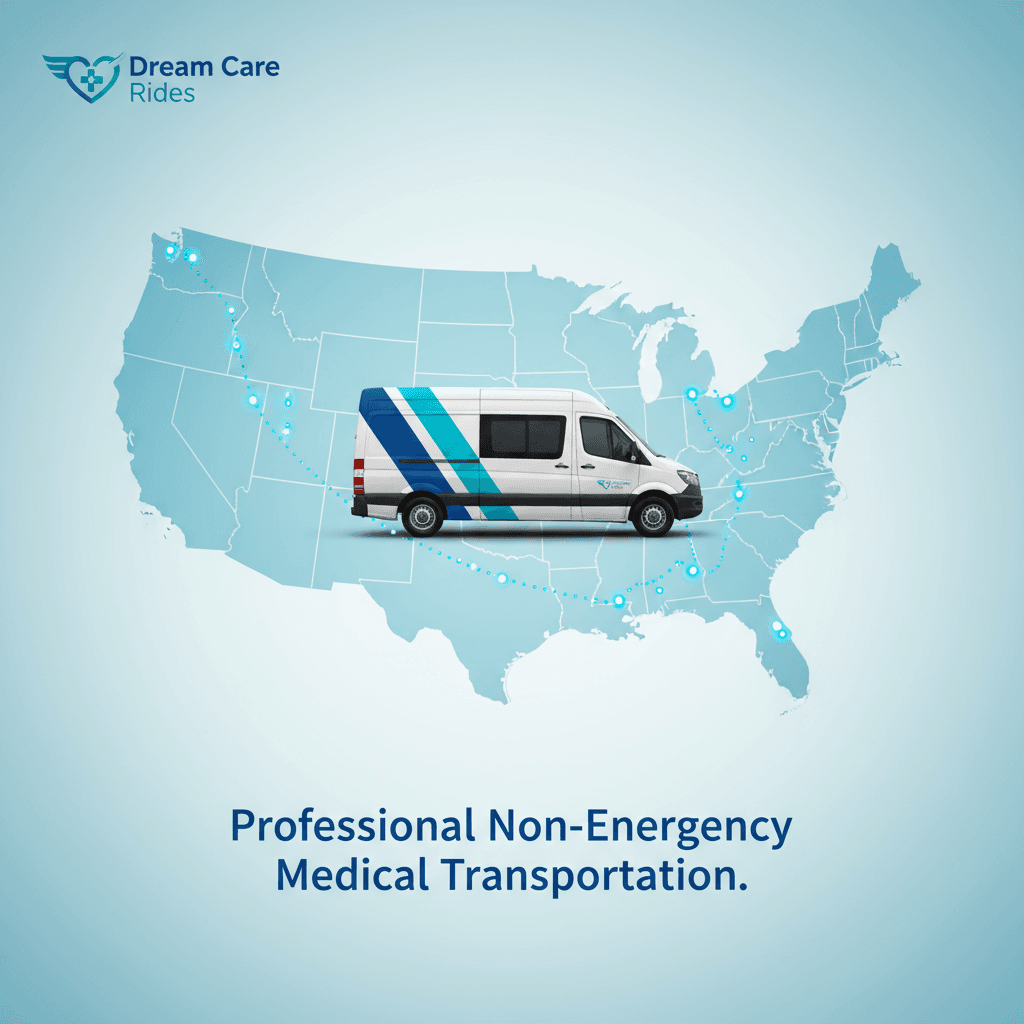
Cross-country medical transport moves patients hundreds or thousands of miles between states — from a hospital in Florida to a rehab center in Illinois, from a nursing facility in Arizona to a family home in Indiana, or from a surgical center in California to a skilled nursing facility in Ohio. Ground transport for these distances costs about $2,000 to $28,000+ before tolls, depending on distance, vehicle type, and patient acuity. Air ambulance for the same routes costs $15,000 to $40,000+. Before you book either option, there are five things every patient and family member needs to understand.
1. Licensing Matters — Verify Interstate Operating Authority
Any company transporting patients across state lines must hold federal interstate operating authority issued by the Federal Motor Carrier Safety Administration (FMCSA). This means a USDOT number and, for for-hire carriers, an MC (Motor Carrier) number. These are not optional. A company operating across state lines without this authority is doing so illegally, and your patient has no federal regulatory protection if something goes wrong.
Before you book, ask the provider for their USDOT number. Then verify it on the FMCSA's SAFER System website (safer.fmcsa.dot.gov). Check that their operating authority status shows "AUTHORIZED" and that their safety record does not include out-of-service orders. Also confirm that their insurance is current — the FMCSA database shows the insurance filing status.
Beyond federal authority, some states require additional permits or licenses for non-emergency medical transportation providers operating within their borders. Illinois, for example, requires NEMT providers to be licensed through the Illinois Department of Public Health (IDPH). If your trip crosses three or four states, the provider should be able to explain which state-level requirements apply to your route.
Dream Care Rides holds full interstate operating authority for cross-country medical transport. Call (708) 505-6994 to verify our credentials or to get a quote for your route. You can also learn more on our interstate medical transport page.
2. Ground vs. Air — When Ground Transport Saves $10,000+
Families facing a cross-country medical transfer often assume air ambulance is the only option. It is not. Ground transport is medically appropriate for the majority of stable patients, and the cost difference is enormous.
| Transport Type | 500 Miles | 1,000 Miles | 2,000+ Miles |
|---|---|---|---|
| Ground Ambulatory (sedan/SUV) | $2,900 – $3,400 | $5,900 – $6,700 | $11,900 – $13,500+ |
| Ground Wheelchair (ADA van) | $3,400 – $3,900 | $6,900 – $7,800 | $13,900 – $15,700+ |
| Ground Stretcher (ambulette) | $6,100 – $6,900 | $12,100 – $13,700 | $24,100 – $27,200+ |
| Air Ambulance (fixed wing) | $15,000 – $25,000 | $20,000 – $35,000 | $25,000 – $40,000+ |
Ground transport is the right choice when the patient is medically stable, does not require in-flight medical interventions (ventilator management, IV drip titration, cardiac monitoring with intervention capability), and can tolerate a multi-day road trip with scheduled rest stops. That describes the majority of long-distance transfers — post-surgical patients returning home, elderly patients relocating closer to family, and patients discharged from out-of-state hospitals who need to get back to their home state.
Air ambulance is necessary when the patient is critically ill, time-sensitive (organ transplant, emergency transfer), or when the ground route would take so long that the patient's condition could deteriorate. For a 2,000-mile stretcher transfer, ground transport takes 3 to 4 days. Air takes 4 to 6 hours. If the patient's medical team says time is a factor, air is the answer. If stability is confirmed and time is flexible, ground saves $10,000 to $30,000.
For a detailed cost breakdown, see our long-distance medical transport cost guide.
3. Multi-Day Trips Require Serious Planning
A cross-country ground transport trip is not a single drive. A 1,500-mile route takes approximately 24 to 30 hours of actual driving time. Federal hours-of-service regulations limit commercial drivers to 11 hours of driving within a 14-hour on-duty window, followed by a mandatory 10-hour rest period. That means a 1,500-mile trip requires a minimum of two driving days plus an overnight stop.
Here is what multi-day trip planning involves:
- Driver rotation or overnight stops: Some providers use a two-driver team that rotates driving shifts, allowing the vehicle to cover more ground per day. Others use a single driver with planned hotel stops. Two-driver teams cost more but reduce total trip time by 30% to 50%.
- Rest stops every 2 to 3 hours: For patient comfort, the vehicle stops every 2 to 3 hours for restroom breaks, hydration, repositioning (for stretcher patients), and medication administration if needed. These stops add 30 to 60 minutes per stop to the total trip time.
- Overnight accommodations: For single-driver trips, the provider arranges an overnight stay at a hotel near the route. The patient stays in the vehicle (which is climate-controlled and comfortable) or transfers to a hotel room if ambulatory or in a wheelchair. For stretcher patients, the patient typically remains on the stretcher in the vehicle overnight with the driver or attendant nearby. Some providers arrange a brief admission to a local skilled nursing facility for overnight care.
- Meals and supplies: The provider or family packs meals, snacks, water, and any medical supplies (oxygen tanks, medications, wound care supplies) for the entire trip. The provider should confirm what they supply versus what the family needs to provide.
- Route planning: The driver follows a pre-planned route that avoids mountain passes (important for oxygen-dependent patients at altitude), construction zones, and areas with limited medical facilities. If the patient's condition deteriorates en route, the driver needs to know the nearest hospital at every point along the route.
When you call Dream Care Rides at (708) 505-6994, we walk you through the entire trip plan — route, stops, timeline, and what to pack. See our long-distance medical transport page for more details on how we plan multi-day trips.
4. Insurance May Cover More Than You Think
Many families assume long-distance medical transport is entirely out-of-pocket. That is not always the case. Several insurance mechanisms can partially or fully cover cross-country medical transport:
- Medicaid: If the patient has Medicaid and is being transferred for a Medicaid-covered medical service, the receiving state's Medicaid program may cover the transport. This requires prior authorization from the managed care organization (MCO) and a Physician Certification Statement (PCS) confirming medical necessity. Medicaid coverage for long-distance transport varies significantly by state — Illinois Medicaid, for example, covers NEMT to the nearest appropriate provider, which can include out-of-state facilities if no in-state option exists.
- Medicare Advantage: Some Medicare Advantage plans include non-emergency medical transportation as a supplemental benefit. Check with the plan's member services department. Original Medicare (Parts A and B) does not cover NEMT, but Advantage plans sometimes do.
- Private health insurance: Certain private insurance plans cover medically necessary patient transfers, especially when the transfer is from a hospital that cannot provide the required level of care to one that can. The key phrase is "medically necessary transfer" — get the referring physician to document why the transfer is needed.
- Workers' compensation: If the patient's condition is work-related, workers' comp may cover transport to a designated treatment facility, even if that facility is in another state. The employer's workers' comp insurer handles authorization.
- Veterans Affairs (VA): Veterans enrolled in VA healthcare may be eligible for Beneficiary Travel benefits, which cover transport to VA medical facilities. This can include long-distance ground transport.
Dream Care Rides works with all major insurance types. We can help you navigate prior authorization and documentation requirements. Call (708) 505-6994 to discuss your coverage options before booking.
5. Book Early — Cross-Country Trips Need 5 to 7 Days Lead Time
Unlike a local NEMT trip that can sometimes be booked 24 to 48 hours in advance, cross-country medical transport requires significantly more planning. Here is why:
- Vehicle and crew allocation: The provider must dedicate a vehicle and one or two crew members for multiple days. That vehicle is unavailable for local trips during the entire cross-country run. Providers need advance notice to schedule around existing commitments.
- Route and logistics planning: The provider plans the route, identifies rest stops, arranges overnight accommodations, and confirms fuel and supply logistics. This takes 1 to 2 days.
- Insurance authorization: If Medicaid, Medicare Advantage, or private insurance is covering the trip, prior authorization can take 3 to 5 business days. Start this process immediately when the transfer is decided.
- Medical documentation: The sending facility needs to prepare discharge paperwork, medication lists, care instructions, and a PCS if insurance is involved. Allow 1 to 2 days for this.
- Coordination with receiving facility: The receiving hospital, rehab center, or skilled nursing facility needs to confirm the admission date and time. The transport date must align with their availability.
The ideal booking timeline is 5 to 7 days before the desired transport date. For urgent situations — a patient who needs to be moved within 48 hours — call (708) 505-6994 immediately. Dream Care Rides can expedite cross-country transport when medically necessary, but advance planning always produces a smoother trip for the patient.
How to Get Started
If you need cross-country medical transport for yourself or a family member, the first step is a phone call. Call Dream Care Rides at (708) 505-6994 and provide:
- Pickup location (hospital, facility, or home address with city and state)
- Destination address (city and state, facility name if applicable)
- Patient's mobility status (ambulatory, wheelchair, or stretcher)
- Target transport date
- Insurance information (if seeking coverage)
We provide a detailed quote within 24 hours, including the route plan, estimated travel time, crew configuration, and total cost. No obligation, no pressure. Every cross-country trip starts with a conversation.
Frequently Asked Questions
How much does cross-country medical transport cost?
Ground transport costs about $2,000 to $28,000+ before tolls, depending on distance and vehicle type. Ambulatory (sedan/SUV) is least expensive at $50–$60 base plus $3.00 per mile after the first 3 miles. Wheelchair van costs $60–$70 base plus $3.50 per mile after the first 3 miles. Stretcher transport costs $350–$400 base plus $6.00 per mile after the first 5 miles. Loaded miles past 50 bill at the long-distance rate: $4.50/mi ambulatory, $5.25/mi wheelchair, $9.00/mi stretcher. Call (708) 505-6994 for a quote on your specific route.
How long does a cross-country ground transport take?
A 1,000-mile trip takes approximately 2 to 3 days including required rest stops and overnight breaks. A 2,000-mile trip takes 3 to 5 days. Two-driver teams can reduce these times by 30% to 50%.
Is cross-country medical transport covered by insurance?
It can be. Medicaid may cover transport for covered medical services with prior authorization. Medicare Advantage plans sometimes include NEMT benefits. Workers' compensation covers work-related transfers. Private insurance may cover medically necessary transfers. Call (708) 505-6994 and we help you explore your coverage options.
What is the difference between cross-country ground transport and air ambulance?
Ground transport uses a sedan, wheelchair van, or ambulette and takes multiple days for long distances. It costs about $2,000 to $28,000+ before tolls. Air ambulance uses a fixed-wing aircraft and covers the same distance in hours. It costs $15,000 to $40,000+. Ground is appropriate for stable patients; air is for critical or time-sensitive transfers.
Can you transport a stretcher patient cross-country?
Yes. Dream Care Rides provides cross-country stretcher transport with a two-person crew (driver and attendant). The patient remains on the stretcher for the entire trip with continuous monitoring. Rest stops every 2 to 3 hours allow repositioning, hydration, and restroom needs. Call (708) 505-6994 to arrange stretcher transport.
Do I need a doctor's order for cross-country medical transport?
For private pay, no physician order is required. For Medicaid or insurance-covered transport, a Physician Certification Statement (PCS) confirming medical necessity is required. Dream Care Rides can help coordinate this documentation with the treating physician.
What states does Dream Care Rides serve for cross-country transport?
Dream Care Rides provides long-distance medical transport to and from all 48 contiguous states. Our home base is Olympia Fields, IL (20000 Governors Dr Suite 103H). Most trips originate from or terminate in the greater Chicago area and Midwest, but we serve routes nationwide.
What happens if the patient's condition worsens during the trip?
Our crew is CPR and First Aid certified and monitors the patient throughout the trip. If the patient's condition changes, the crew contacts 911 and transports the patient to the nearest emergency department. We pre-identify hospitals along the entire route before departure for exactly this reason.
Need Medical Transportation?
Call us directly or book online. Upfront pricing, no hidden fees.
Founder & CEO, Dream Care Rides
Licensed NEMT provider headquartered in Olympia Fields, IL.